





What Is a FENSA Certificate? The Organisation Behind the Certificate
FENSA stands for Fenestration Self-Assessment Scheme. That’s a mouthful, so let’s break it down into plain English. “Fenestration” is simply the technical term for windows, doors, roof lights, and other glazed openings in a building. The “Self-Assessment Scheme” part refers to the way the system works: rather than requiring every window installation to be directly inspected by a local authority building control officer, the government authorised a scheme whereby approved companies can self-certify that their work complies with building regulations.
FENSA was established in April 2002, introduced alongside updated building regulations that required replacement windows and doors to meet minimum energy efficiency standards. Before FENSA existed, homeowners who replaced their windows technically needed to apply to their local council for building regulations approval — a time-consuming and often expensive process. FENSA streamlined all of that.
Today, FENSA is the largest and most widely recognised glazing competent person scheme in the UK. It operates as an industry body that approves installation companies, monitors their compliance with building regulations, and provides the certification paperwork that homeowners and conveyancers rely on.
FENSA was introduced in April 2002 by the Department for Communities and Local Government as part of new building regulations requiring energy-efficient replacement glazing. It now covers over 10 million installations across England and Wales.
It’s worth noting that FENSA operates in England and Wales only. Scotland and Northern Ireland have separate building regulations frameworks and their own competent person schemes — so if you’re in those areas, you’ll be looking for equivalent schemes rather than FENSA specifically.
What Is a FENSA Certificate for Windows and Doors?
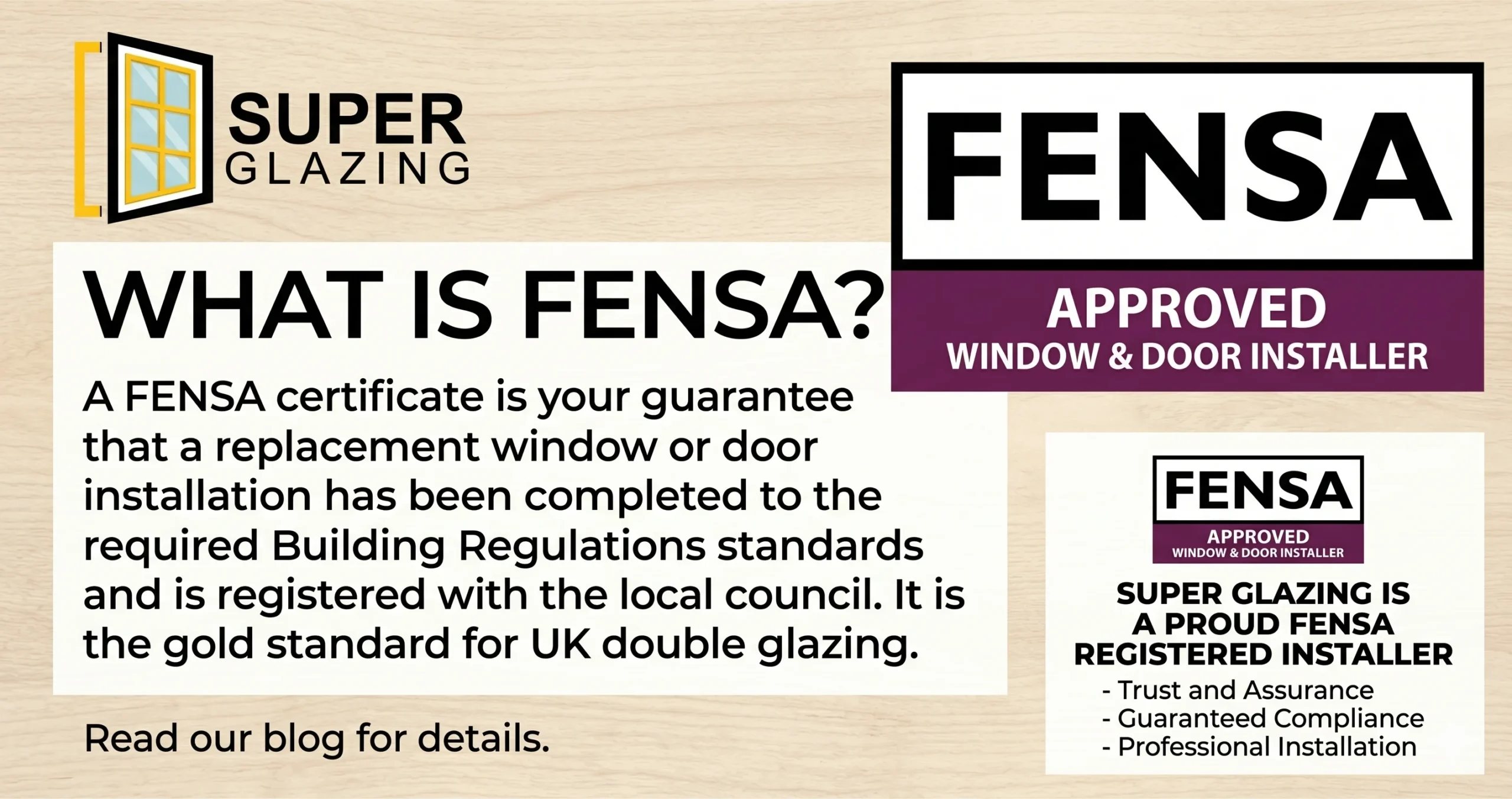
A FENSA certificate is an official document that confirms your replacement windows or doors were installed in compliance with current building regulations. Think of it as your proof — on paper — that the work was done to the required legal standard.
When a FENSA registered company like Super Glazing completes an installation, they submit the details to FENSA within 30 days of finishing the work. FENSA then notifies your local authority building control department on your behalf (this is the “self-certification” element of the scheme) and issues a certificate to the homeowner.
What information does a FENSA certificate contain?
A standard FENSA certificate will include:
- The address of the property where work was carried out
- A description of the work completed (e.g., “replacement of 6 windows and 1 door”)
- The date of installation
- The name and FENSA registration number of the installing company
- A unique certificate reference number
- Confirmation that the work complies with relevant building regulations
- The installer’s insurance-backed guarantee details (more on this below)
A FENSA certificate is not just a receipt for work done — it's a legal document that confirms your installation met building regulations, protects your property's value, and gives future buyers the assurance they need.
— Super Glazing Team
Critically, the certificate doesn’t just confirm the work was done — it confirms it was done correctly by a company that operates within a regulated framework. That distinction matters enormously when it comes to selling your home, making insurance claims, or dealing with any future dispute about the installation.
Is a FENSA certificate the same as a building regulations certificate?
Functionally, yes — a FENSA certificate achieves the same outcome as going through a local authority building control application. The difference is in the process: building regulations approval through your local council involves submitting an application (which costs money and takes time), potentially having an inspector visit, and receiving formal approval. FENSA replaces all of that with a streamlined self-certification process, provided the installer is registered with the scheme.
The legal status is equivalent. Both a FENSA certificate and a local authority building regulations completion certificate satisfy the requirement for proof of compliance. Solicitors, mortgage lenders, and conveyancers accept either — but for replacement windows and doors, the FENSA route is almost always faster and simpler.
When a FENSA registered company like Super Glazing completes an installation, they submit the details to FENSA within 30 days of finishing the work. FENSA then notifies your local authority building control department on your behalf (this is the “self-certification” element of the scheme) and issues a certificate to the homeowner.
FENSA Guarantee: What Does It Cover?
This is where a lot of homeowners have questions, because the “FENSA guarantee” isn’t quite what many people assume. Let’s be precise about what it is and isn’t.
FENSA itself does not provide a product warranty or a workmanship guarantee in the traditional sense. What FENSA does is require all its registered member companies to hold an insurance-backed guarantee (IBG). This is a crucial distinction, so let’s unpack it properly.
What is an insurance-backed guarantee?
An insurance-backed guarantee is a policy that protects the homeowner in the event that the installation company ceases to trade — through insolvency, closure, or any other reason — and is therefore unable to honour its own warranty. The IBG steps in where the company cannot.
Every FENSA registered company must arrange IBG cover for its customers. This is not optional — it’s a requirement of FENSA membership. So when you have work done by a FENSA registered installer, you’re not relying solely on that company’s continued existence to protect your investment. There’s an insurance policy sitting behind it.
What the FENSA Guarantee Covers
The insurance-backed guarantee associated with FENSA registration typically covers: structural installation defects, failure of sealed units (condensation between panes), failure of hardware (locks, handles, hinges) within the guarantee period, and water ingress caused by the installation. Specific terms vary by the IBG provider used by your installer.
What the FENSA guarantee does NOT cover
Important Exclusions
The insurance-backed guarantee does not cover: accidental damage, damage caused by misuse or neglect, cosmetic deterioration that doesn't affect performance, damage resulting from building movement or subsidence, or any issues that arise from modifications made by a third party after installation. Always read the specific terms of your guarantee document.
In addition to the IBG, most reputable FENSA registered companies — including Super Glazing — also provide their own separate workmanship guarantee. This is a direct guarantee from the installing company on the quality of their work, typically covering a period of several years. The IBG exists as a safety net specifically if that company goes out of business during the guarantee period.
How long does the FENSA guarantee last?
The duration varies depending on the IBG provider and the terms offered by the individual installing company. As a general reference point, many FENSA-associated guarantees run for a minimum of five to ten years, though longer terms are available through certain providers and premium installers. Your specific guarantee period will be stated on your certificate documentation.
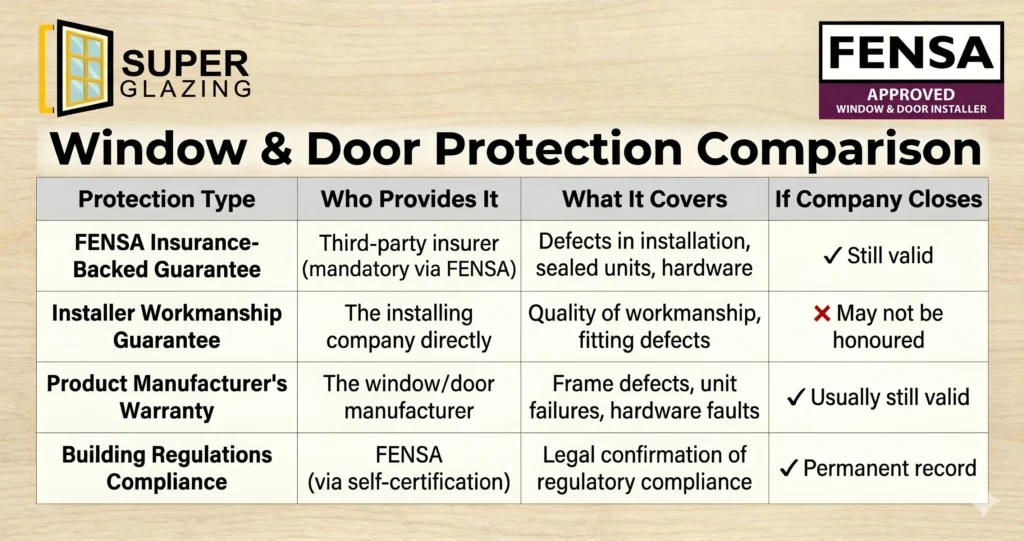
Window & Door Protection Comparison
| Protection Type | Who Provides It | What It Covers | If Company Closes |
|---|---|---|---|
| FENSA Insurance-Backed Guarantee | Third-party insurer (mandatory via FENSA) | Defects in installation, sealed units, hardware failure | ✓ Still valid |
| Installer Workmanship Guarantee | The installing company directly | Quality of workmanship, fitting defects | ✗ May not be honoured |
| Product Manufacturer’s Warranty | The window/door manufacturer | Frame defects, unit failures, hardware faults | ✓ Usually still valid |
| Building Regulations Compliance | FENSA (via self-certification) | Legal confirmation of regulatory compliance | ✓ Permanent record |
Understanding this layered approach to protection is important because it means you actually have multiple lines of cover when you use a FENSA registered installer — not just one blanket “guarantee.” Each layer protects a different aspect of your installation.
How to Do a FENSA Certificate Check
If you’ve recently bought a property, inherited a house, or simply can’t locate the original paperwork from a previous installation, you may need to do a FENSA certificate check to confirm whether registered work was carried out and when. Here’s how.
Option 1: Check via the FENSA website
FENSA maintains a public online register of completed installations. To perform a certificate check, you can visit the FENSA website (fensa.org.uk) and use their property search tool. You’ll need the full address of the property. The search will show whether any FENSA-registered work has been recorded at that address, along with the date of registration.
Practical Tip
The FENSA online register shows that an installation was registered — it doesn't always display the full certificate details publicly. If you need a replacement copy of the actual certificate, you'll need to contact FENSA directly or the company that performed the original installation.
Option 2: Request a replacement certificate from FENSA
If you need a copy of the actual certificate — for a property sale, a mortgage application, or insurance purposes — you can request a replacement from FENSA. There is usually a small administrative fee for this. You’ll need the property address and, ideally, an approximate date of the installation.
Option 3: Check with your local authority
Because FENSA registered installations are notified to the relevant local authority building control department, you can also make a formal enquiry to your council to confirm whether compliant replacement glazing was registered at the property. This may take longer than the FENSA route but can be useful if the FENSA records are incomplete or if the work predates certain record periods.
What if there's no FENSA record for a property?
If you’re buying a house and discover there’s no FENSA record for what appear to be relatively new windows, this raises an important question that needs resolving before completion. There are a few possible explanations:
- The windows were installed by a non-FENSA-registered company and no building regulations application was made — which means the installation may be technically non-compliant
- The windows are older than they look and predate the 2002 introduction of FENSA (in which case the regulations would not have applied)
- A local authority building regulations application was made instead of using FENSA — this is less common but is a valid alternative route
- An administrative error means the installation wasn’t registered, even though it was done correctly
Your solicitor should raise this during conveyancing. In some cases, the seller may be able to obtain retrospective certification or provide an indemnity insurance policy — a separate form of protection that covers a buyer in the event that the lack of documentation causes a future problem.
Important for Property Buyers
If a property has replacement windows or doors installed after April 2002 with no FENSA certificate and no evidence of a local authority building regulations application, your conveyancer should flag this as a potential issue. Don't proceed without taking advice — the cost of sorting it out after completion is almost always higher than dealing with it before exchange.
How to Get a FENSA Certificate for Your Property
Here’s the simple truth: if you use a FENSA registered installer, you don’t need to do anything to get your certificate. It’s issued automatically as part of the installation process. The responsibility is entirely on the registered company — not on you as the homeowner.
Here’s how the process works in practice when you use a FENSA registered company like Super Glazing:
- Installation is completed. Your new windows or doors are fitted by the FENSA registered company.
- Notification to FENSA. Within 30 days of completing the work, the company submits details of the installation to FENSA — including the property address, work description, and compliance confirmation.
- Local authority notification. FENSA notifies your local authority building control department on your behalf. This fulfils the legal requirement for building regulations compliance without you having to make any application.
- Certificate issued. FENSA issues a certificate confirming the work, which is sent to you as the homeowner. Keep this document safely — ideally with your property deeds or other important home documents.
- IBG arranged. The installer arranges the insurance-backed guarantee, which is typically detailed on or alongside your FENSA certificate.
What if I want to use a non-FENSA company?
You can use a non-FENSA installer, but if you do, the responsibility for obtaining building regulations compliance shifts to you. You would need to submit a building regulations application to your local authority before the work starts, pay the relevant fee, and have the work inspected by a building control officer. Alternatively, you could apply for a regularisation certificate after the work is done — but this is a more complicated and expensive route, and not all councils offer it.
In short: using a non-FENSA installer for replacement windows or doors creates work, cost, and complication for you. It’s one of the most practical reasons to always check FENSA registration before booking any glazing company.
How to Check If a Company Is FENSA Registered
You can verify any company's FENSA registration status using the "Find an Installer" tool on the FENSA website. Simply search by company name, postcode, or registration number. If they're not on the register, they cannot legally self-certify their window and door installations under the FENSA scheme.
Super Glazing: A FENSA Registered Company You Can Verify
Super Glazing is a fully FENSA registered glazing company operating across South and West Yorkshire. Our FENSA registration means several specific things for every customer we work with:
- Every window and door installation we complete is notified to FENSA and your local authority building control — automatically, without you having to arrange anything
- You receive a FENSA certificate for every eligible installation, giving you permanent documented proof that the work complied with building regulations
- An insurance-backed guarantee is arranged as part of every installation — so your protection doesn’t depend solely on Super Glazing’s continued existence as a business
- Our work is carried out in accordance with the standards required to maintain our FENSA registration — which is monitored and subject to audit
You can verify Super Glazing’s FENSA registration directly on the FENSA website at any time. We’d encourage you to do exactly that before booking any glazing company — including us. An installer that claims to be FENSA registered should be findable on the public register. If they’re not, they cannot issue FENSA certificates, and you should find out why before you proceed.
We'd encourage every homeowner to check FENSA registration before booking any glazing company — including us. Transparency isn't just good practice; it's the foundation of trust in this industry.
— Super Glazing Team
Why does FENSA registration matter when choosing a glazing company?
When you’re comparing quotes for new windows or doors, price is obviously a factor. But the FENSA registration status of the company you’re considering should sit right alongside it — because the difference between a FENSA registered installer and an unregistered one isn’t just administrative. It has real financial and legal implications.
A non-FENSA company cannot issue you a certificate. They cannot self-certify compliance with building regulations. If you use them, you carry the burden of proving the installation was done correctly. And when you come to sell your home — often years or decades later — the absence of that certificate can cause significant problems at the worst possible moment.
We’ve seen firsthand how this plays out. Homeowners who used cheap, unregistered installers years ago come to us for help when their solicitor raises the missing documentation during a house sale. By that point, the original company may no longer exist. The options for resolving it are limited and often costly. It’s a headache that’s entirely avoidable by checking FENSA registration at the start.
Do You Always Need a FENSA Certificate? Common Exemptions Explained
FENSA certification applies specifically to replacement windows and doors in existing domestic properties in England and Wales. There are some situations where FENSA certification does not apply or is not required — and it’s worth understanding these so you have accurate expectations.
When FENSA certification IS required
- Replacing existing windows or doors with new ones in any residential property in England or Wales
- Installing a new door or window where there was previously a solid wall (though this may also require planning permission)
- Work on most properties built after 2002 where building regulations apply
When FENSA certification may NOT apply
- Listed buildings: Listed buildings have their own consent requirements that sit outside FENSA — you’ll typically need listed building consent from your local authority
- Conservation areas: Certain types of work in conservation areas may require planning permission rather than, or in addition to, building regulations compliance
- New-build properties: Windows in a new build are covered under the original building regulations approval for the whole development — not FENSA
- Scotland and Northern Ireland: As noted earlier, FENSA does not operate in these areas
- Commercial properties: FENSA is a domestic scheme — commercial buildings fall under different regulations
How to Check If a Company Is FENSA Registered
You can verify any company's FENSA registration status using the "Find an Installer" tool on the FENSA website. Simply search by company name, postcode, or registration number. If they're not on the register, they cannot legally self-certify their window and door installations under the FENSA scheme.
Summary: Key Takeaways on FENSA Certificates
We’ve covered a lot of ground. Here’s the condensed version for anyone who wants the main points without the full detail:
- FENSA is a competent person scheme that allows registered installers to self-certify that replacement windows and doors comply with building regulations in England and Wales
- A FENSA certificate is official documentation confirming that your installation was done to the required legal standard — equivalent to a local authority building regulations completion certificate
- You need this certificate to prove compliance when selling your home, making mortgage applications, and for insurance purposes
- The FENSA guarantee is an insurance-backed guarantee that protects you if the installing company closes — it’s a mandatory part of FENSA membership
- To get a FENSA certificate, simply use a FENSA registered installer — they handle all the notification and certification automatically
- You can check any installation’s FENSA record via the online register at fensa.org.uk
- Always verify a glazing company’s FENSA registration before booking — it’s searchable on the FENSA website by company name
- Super Glazing is FENSA registered — every installation we complete comes with automatic FENSA notification, certification, and an insurance-backed guarantee
Bottom Line for Homeowners
Choosing a FENSA registered company for your window and door installation isn't just about paperwork — it's about protecting your home's value, your legal position, and your peace of mind for years to come. The certificate you receive is a long-term asset, not a formality.
Super Glazing - FENSA Registered
Ready to Book a FENSA-Certified Installation?
Super Glazing installs uPVC windows, double glazing, triple glazing, and doors across South and West Yorkshire. Every installation is FENSA registered, fully certified, and backed by an insurance-backed guarantee. Free surveys, fixed quotes, no hard sell.